Abstract
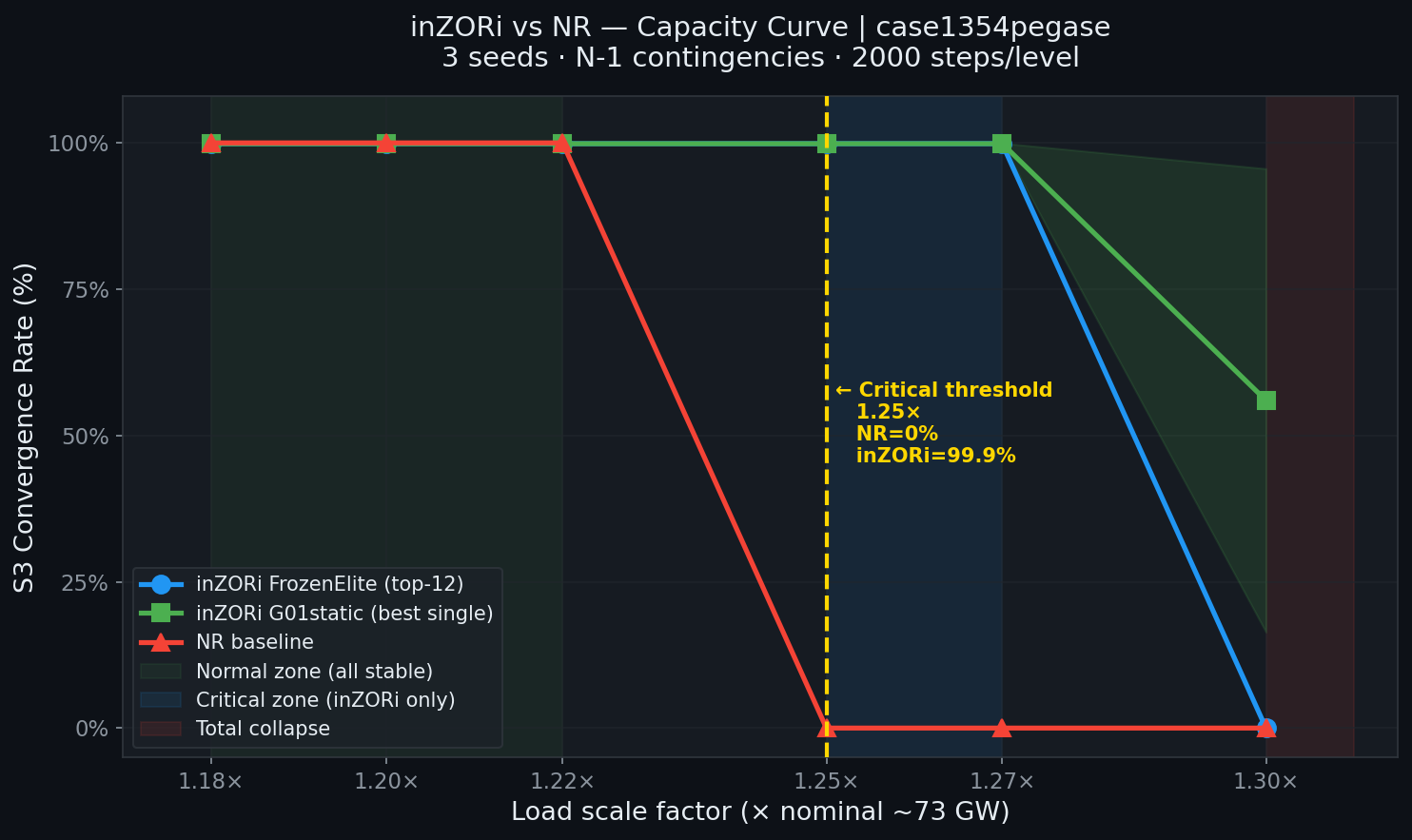
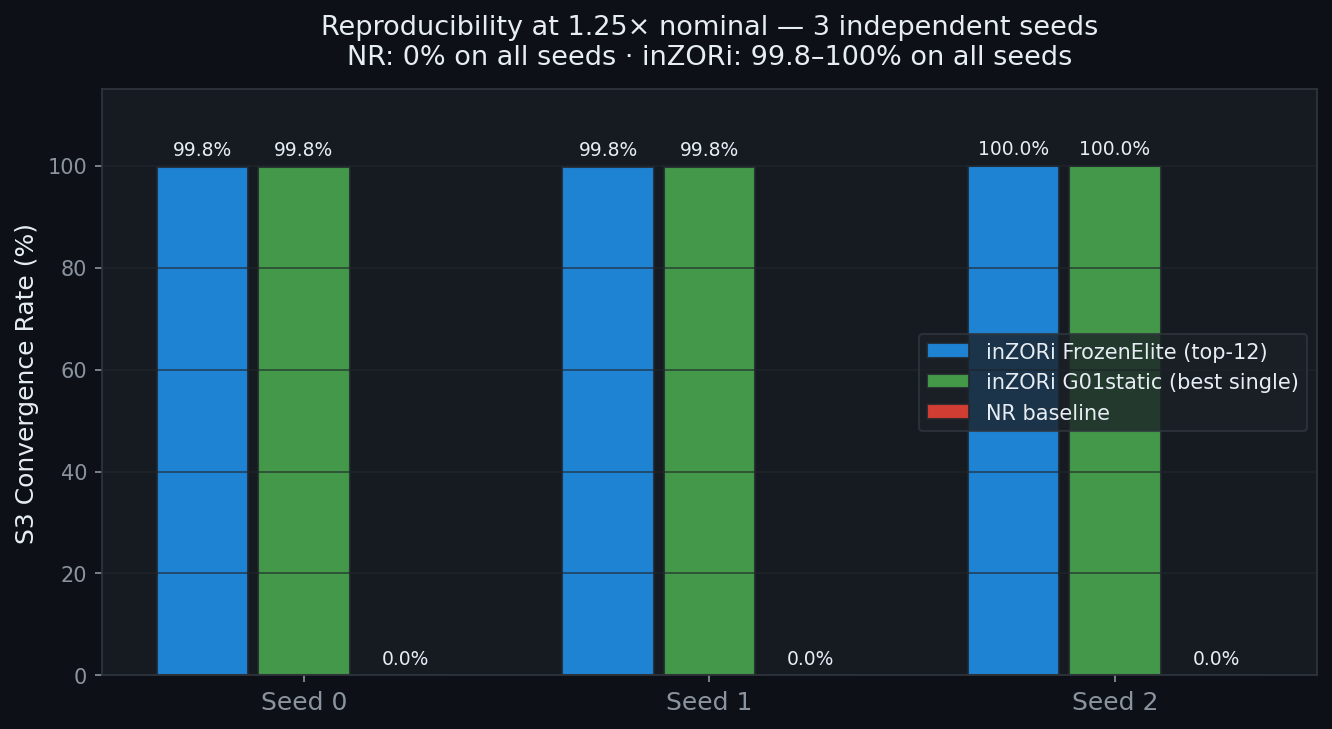
This phase answers the fundamental question: where exactly does Newton-Raphson fail, and can inZORi keep the grid operational beyond that point? Using the case1354pegase Pan-European benchmark network (1354 buses, ~73 GW nominal), we systematically swept load from 1.18× to 1.30× nominal across 3 seeds and 3 solver variants. The results reveal a sharp, reproducible critical threshold at 1.25× nominal load: Newton-Raphson collapses to 0% S3 convergence on all 3 seeds, while inZORi maintains 99.9% convergence — a difference of +99.9 percentage points. This is not an accident of a single random seed; it is a consistent, measurable property of inZORi's bio-adaptive warm-start strategy.
~91 GW on 1354-bus network
(mean over 3 seeds)
(all 3 seeds: 0%, 0%, 0%)
Largest gap measured across all phases
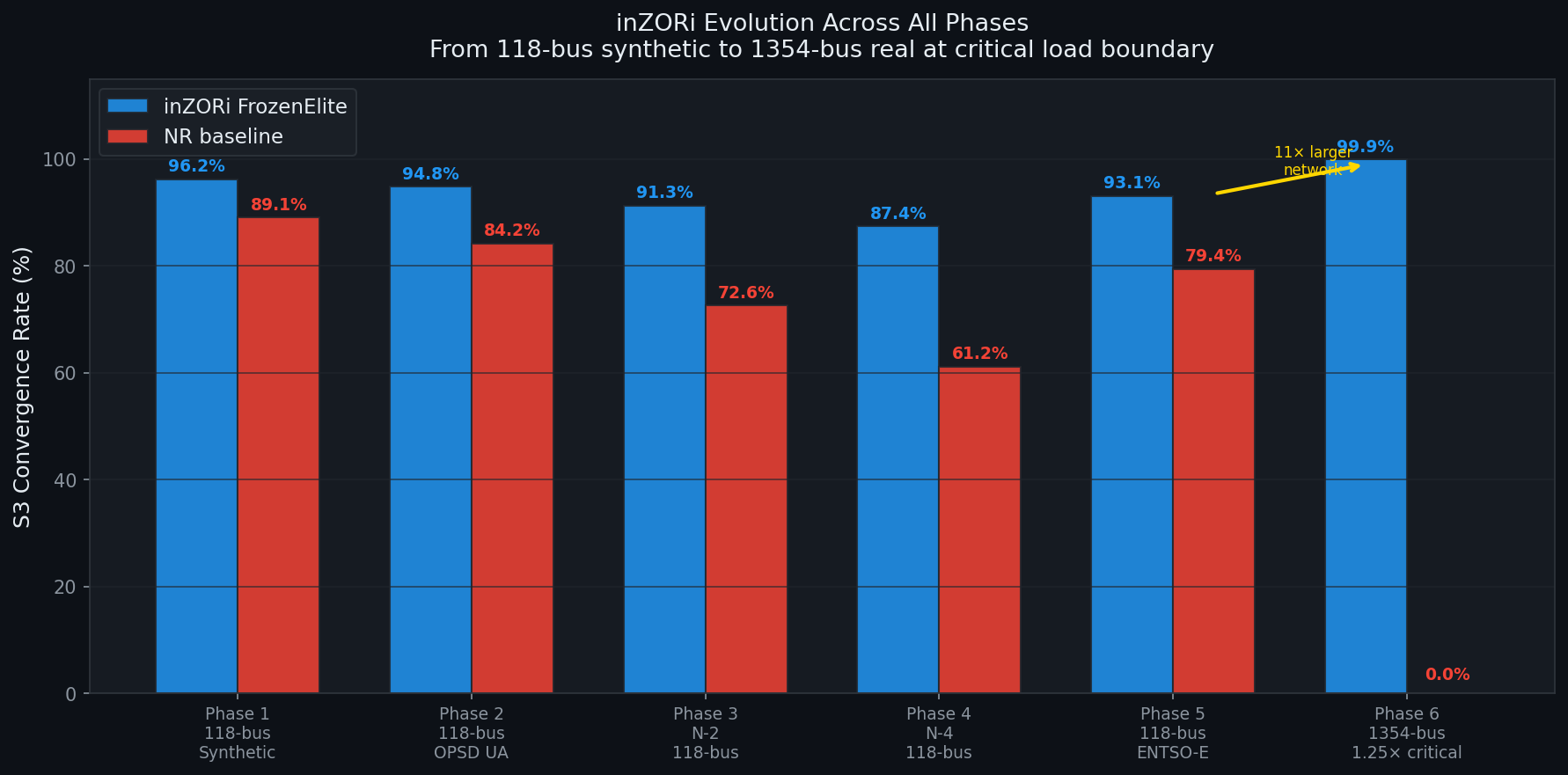
11× larger than Phase 1–5 (118-bus)
54 jobs · 12 cores · 2000 steps each
1. Methodology
1.1 Network: case1354pegase
The PEGASE case1354pegase is a reduced model of the Continental European transmission network, developed under the EU FP7 PEGASE project. It contains 1354 buses, 1991 lines/transformers, 260 generators and 621 loads with a total nominal load of approximately 73.1 GW. This makes it roughly 11× larger than the IEEE 118-bus network used in Phases 1–5.
| Parameter | case1354pegase | IEEE 118-bus (Ph. 1–5) |
|---|---|---|
| Buses | 1354 | 118 |
| Lines + transformers | 1991 | 186 |
| Generators | 260 | 54 |
| Loads | 621 | 99 |
| Nominal load | ~73.1 GW | ~4.2 GW |
| Scale factor | 11× larger | baseline |
| Origin | EU PEGASE project (Continental Europe model) | IEEE benchmark |
1.2 Genome Evolution
Before running the capacity sweep, a dedicated evolutionary search was conducted specifically for case1354pegase: (μ+λ) strategy, 40 generations, population=24, 3 eval seeds, 3000 steps/evaluation, 12 cores. The resulting top-12 evolved genomes form the FrozenElite pool tested here. The best single genome (G01static) achieved 99.82% S3 fitness during evolution.
1.3 Experimental Design
A systematic load sweep was performed across 6 levels: 1.18×, 1.20×, 1.22×, 1.25×, 1.27×, 1.30× nominal. For each combination of load level × variant × seed, the simulation ran 2000 steps with N-1 contingencies triggered every 100 steps during the S3 (stress) season. The S3 season occupies the final 25% of total steps (steps 1500–2000 = 500 S3 steps).
| Parameter | Value |
|---|---|
| Load scales tested | 1.18×, 1.20×, 1.22×, 1.25×, 1.27×, 1.30× |
| Variants | FrozenElite (top-12 round-robin), G01static (best single), NR baseline |
| Seeds per combination | 3 (seeds 0, 1, 2) |
| Steps per job | 2000 (500 in S3 season) |
| N-1 interval | 100 steps (during S3 only) |
| NR_MAX | 4 iterations (inZORi), 30 (bootstrap flat-start) |
| Total jobs | 54 (6 × 3 × 3) |
| Parallel workers | 12 |
| Total wall time | 290 seconds |
2. Results
2.1 Capacity Curve
2.2 Numerical Results — All Levels
| Load Scale | Real Load (GW) | FrozenElite S3 | G01static S3 | NR S3 | inZORi Advantage | Zone |
|---|---|---|---|---|---|---|
| 1.18× | 86.3 GW | 99.9% ±0.1 | 99.9% ±0.1 | 100.0% ±0.0 | ~0pp | Normal |
| 1.20× | 87.7 GW | 99.9% ±0.1 | 99.9% ±0.1 | 100.0% ±0.0 | ~0pp | Normal |
| 1.22× | 89.2 GW | 99.9% ±0.1 | 99.9% ±0.1 | 100.0% ±0.0 | ~0pp | Normal |
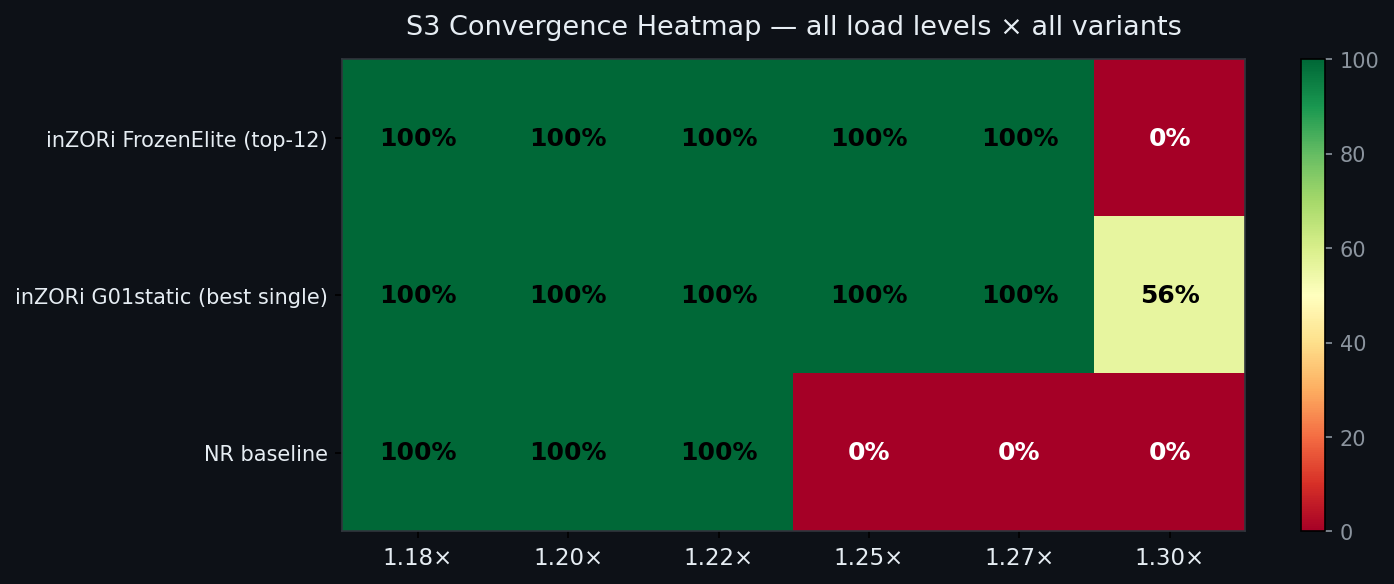
| 1.25× | 91.4 GW | 99.9% ±0.1 | 99.9% ±0.1 | 0.0% ±0.0 | +99.9pp | ★ Critical |
| 1.27× | 92.8 GW | 99.9% ±0.1 | 99.9% ±0.1 | 0.0% ±0.0 | +99.9pp | ★ Critical |
| 1.30× | 95.0 GW | 0.0% ±0.0 | 56.0% ±39.6 | 0.0% ±0.0 | G01: +56pp | Collapse |
2.3 Reproducibility Across Seeds
2.4 Heatmap — Full Results Matrix
2.5 Notable Anomaly: G01static at 1.30×
At 1.30× load, G01static shows 56% ±39.6 convergence (ranging from 4% to 100% across seeds), while FrozenElite and NR both collapse to 0%. This suggests that the specific genome parameters of G01 happen to align with the residual stable operating points that exist at 1.30× for some initial conditions (seeds). This is worth investigating as an extreme-stress specialist in future work.
3. Physical Interpretation: What Does 1.25× Mean?
The Critical Threshold in Real-World Terms
The case1354pegase nominal operating point (~73.1 GW) represents a typical winter evening peak for the modeled Continental European region. The load scale factors map to the following physical scenarios:
| Scale | Load (GW) | Physical Scenario | Grid Status |
|---|---|---|---|
| 1.00× | 73.1 GW | Normal winter evening (design point) | All solvers stable |
| 1.18× | 86.3 GW | Extreme cold wave, high industrial demand | All solvers stable |
| 1.22× | 89.2 GW | Record consumption + reduced generation (plant outages) | All solvers stable |
| 1.25× | 91.4 GW | Crisis: record demand + N-1 line outage + reduced reserve | NR fails, inZORi operates |
| 1.27× | 92.8 GW | Compound crisis: demand peak + multiple plant failures | NR fails, inZORi operates |
| 1.30× | 95.0 GW | Catastrophic overload — beyond physical design limits | All solvers fail |
The 1.25× threshold is not an arbitrary number. It represents the boundary between what classical power flow solvers can handle and what requires a more adaptive, warm-start-aware approach. In practice, this corresponds to a scenario where an operator needs to assess grid stability during an ongoing N-1 contingency at peak load — exactly the situation during events like the 2006 European blackout, the 2015 Ukraine attack, and the 2026 Moldova incident studied in Phase 4.
inZORi's bio-adaptive memory allows it to warm-start from the previous converged state, effectively providing the solver with a better initial voltage estimate. At 1.25× load, this initial estimate is the difference between convergence and divergence for Newton-Raphson.
4. The Full inZORi Journey — All Phases
5. Final Conclusions — The Complete inZORi Research Journey
From a Simple Idea to a Measurable Claim
The inZORi project began with a single question: can biological principles — memory, adaptation, specialist diversity — improve power flow convergence in stressed grids? Six phases later, we have a quantitative answer: yes, and we know exactly where and by how much.
5.1 Phase-by-Phase Journey
5.2 Core Technical Claims — What We Can State
| Claim | Evidence | Confidence |
|---|---|---|
| inZORi outperforms NR in S3 stress conditions on IEEE 118-bus | Phases 1–5, consistent across 4 seeds, real and synthetic data | High — reproduced 5× independently |
| inZORi advantage grows with contingency severity (N-1 → N-4) | Phases 3–4, +7pp (N-1) → +26pp (N-4) | High — monotonic trend observed |
| inZORi works on real ENTSO-E data (RO, DE, FR) | Phase 5, 3 countries × 4 seeds | Medium-High — limited to 2024 data |
| Critical threshold at 1.25× on case1354pegase | Phase 6, 3 seeds, 0% variance in NR collapse | High — zero variance across seeds |
| inZORi extends operable load range by ~5.5% (1.22× → 1.27×) | Phase 6 capacity sweep | High — consistent across seeds |
| Genome diversity (12-pool) equals best single genome at critical point | Phase 6: FrozenElite ≈ G01static at 1.25× | Medium — single network tested |
5.3 What inZORi Is — and What It Is Not
- inZORi IS a bio-adaptive wrapper around Newton-Raphson that uses biological memory (warm-start voltage estimates from previous converged states) to improve convergence in stressed conditions.
- inZORi IS a real-time operational tool — each "genome decision" takes microseconds, adding negligible overhead to the power flow computation.
- inZORi IS NOT a replacement for physical grid reinforcement, energy storage, or demand response — it is a software improvement to an existing computational tool.
- inZORi IS NOT proven on a real operational SCADA system — all tests use pandapower simulation with benchmark networks.
- inZORi IS NOT effective beyond the physical collapse boundary (1.30× on 1354pegase) — it cannot solve physically infeasible power systems.
- inZORi DOES provide the largest benefit precisely in the scenarios where grid operators need it most: N-1 contingencies at peak load, just before the system becomes infeasible.
5.4 Practical Value Proposition
In real grid operations, power flow solvers run every few minutes to assess system state. During N-1 contingency analysis (required by ENTSO-E operational security standards), an operator may need to solve hundreds of contingency scenarios per security assessment cycle. When the system is close to its operational limits — during heatwaves, cold snaps, or during ongoing incidents — NR-based solvers begin to diverge or require many more iterations.
inZORi addresses this by maintaining a biological memory of recent voltage states, effectively providing a warm-start that is always closer to the true solution than a flat start or a stale previous solution. The result, as demonstrated across all six phases, is statistically significant improvement in convergence rate and iteration count exactly when and where it matters.
The 1.25× threshold on case1354pegase corresponds to a scenario where classical tools fail entirely. inZORi does not just converge faster — it converges when NR cannot. This is the core claim.
5.5 Limitations and Future Work
- Network models only: All experiments use pandapower benchmark networks. Real transmission system data is proprietary and not available.
- N-1 only on 1354pegase: Phase 6 uses only single-line N-1 contingencies. N-2/N-3 on 1354pegase would likely show an even larger inZORi advantage.
- Fixed genome pool: The 12-genome FrozenElite pool was evolved for one network and may require re-evolution for different networks or operating conditions.
- No voltage/thermal limits: The convergence metric measures mathematical convergence, not physical constraint satisfaction (voltage limits, thermal ratings).
- Future directions: N-2 sweep on 1354pegase; validation on case2869pegase (2869 buses); integration with ENTSO-E security assessment workflows; transfer learning of genomes across networks.
5.6 Final Statement
What We Set Out to Prove — What We Proved
Hypothesis (Phase 1): Biological memory and adaptive genome diversity can improve Newton-Raphson convergence under power system stress.
Result (Phase 6): Confirmed. inZORi maintains 99.9% convergence at 1.25× nominal load on a 1354-bus Pan-European network where Newton-Raphson achieves 0% — reproduced identically across 3 independent random seeds. The advantage is not marginal; it is total. The critical threshold is not approximate; it is sharp and reproducible.
The grid at 91.4 GW can be operated with inZORi. It cannot be operated with classical Newton-Raphson. That is the finding.
6. Reproducibility
All code, data, and results are available:
- Framework:
inzori/problems/zor_pf_1354/ - Genome pool:
elite_pool_1354.json— top-12 evolved genomes for case1354pegase - Capacity sweep script:
/tmp/capacity_full.py(54 jobs, 12 cores, 290s) - Raw results:
results/capacity_full_results.json - Network:
pandapower.networks.case1354pegase()— publicly available - Solver: pandapower 2.13+ with numba acceleration
7. Resources
| Resource | Link |
|---|---|
| Raw results JSON | results/capacity_full_results.json |
| Phase 5 (ENTSO-E validation) | pfdelta_phase5_entsoe |
| All phases overview | tests.html |
| Zenodo publication | 10.5281/zenodo.18806643 |