PHASE 2 — REAL AC POWER FLOW
inZORi PF-Δ Phase 2: Full Real AC Power Flow on IEEE 118-bus
First deployment of Frozen Elite strategy on pandapower real AC physics · 1.75× stressed load · N-1 every 300 steps

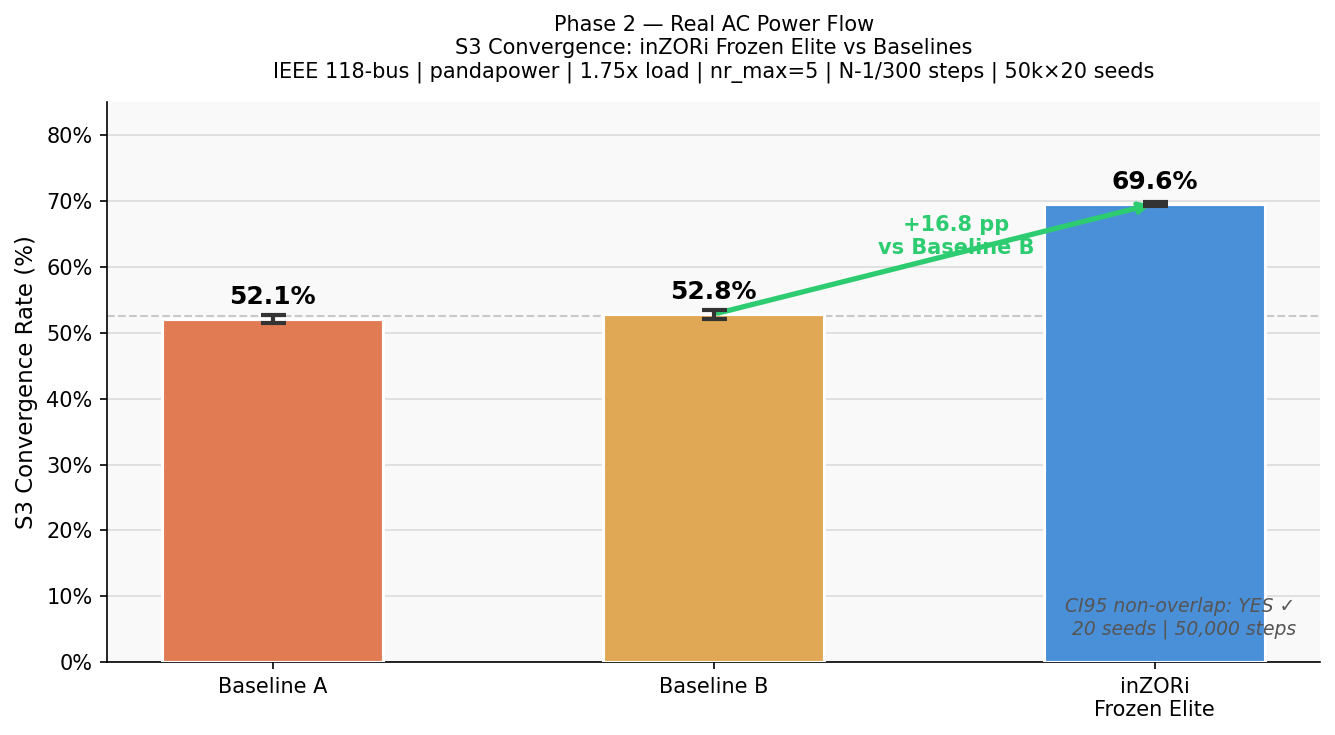
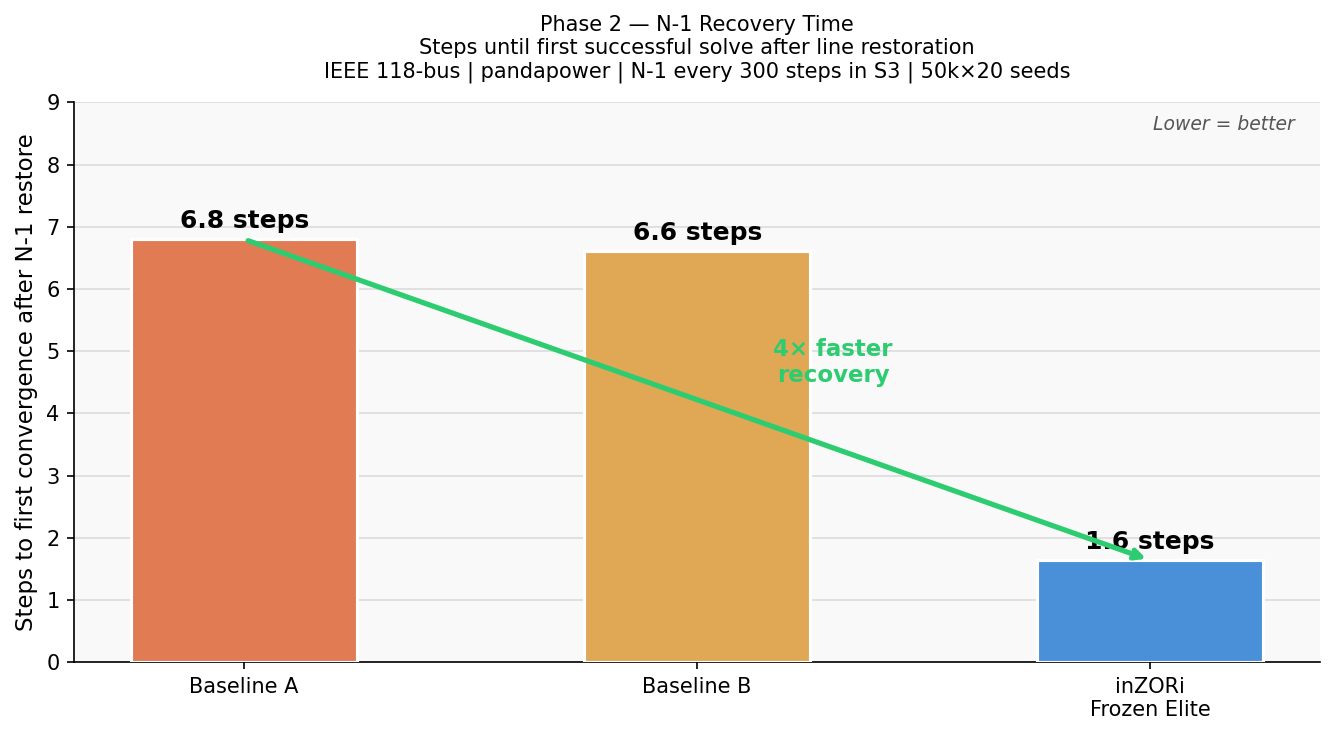
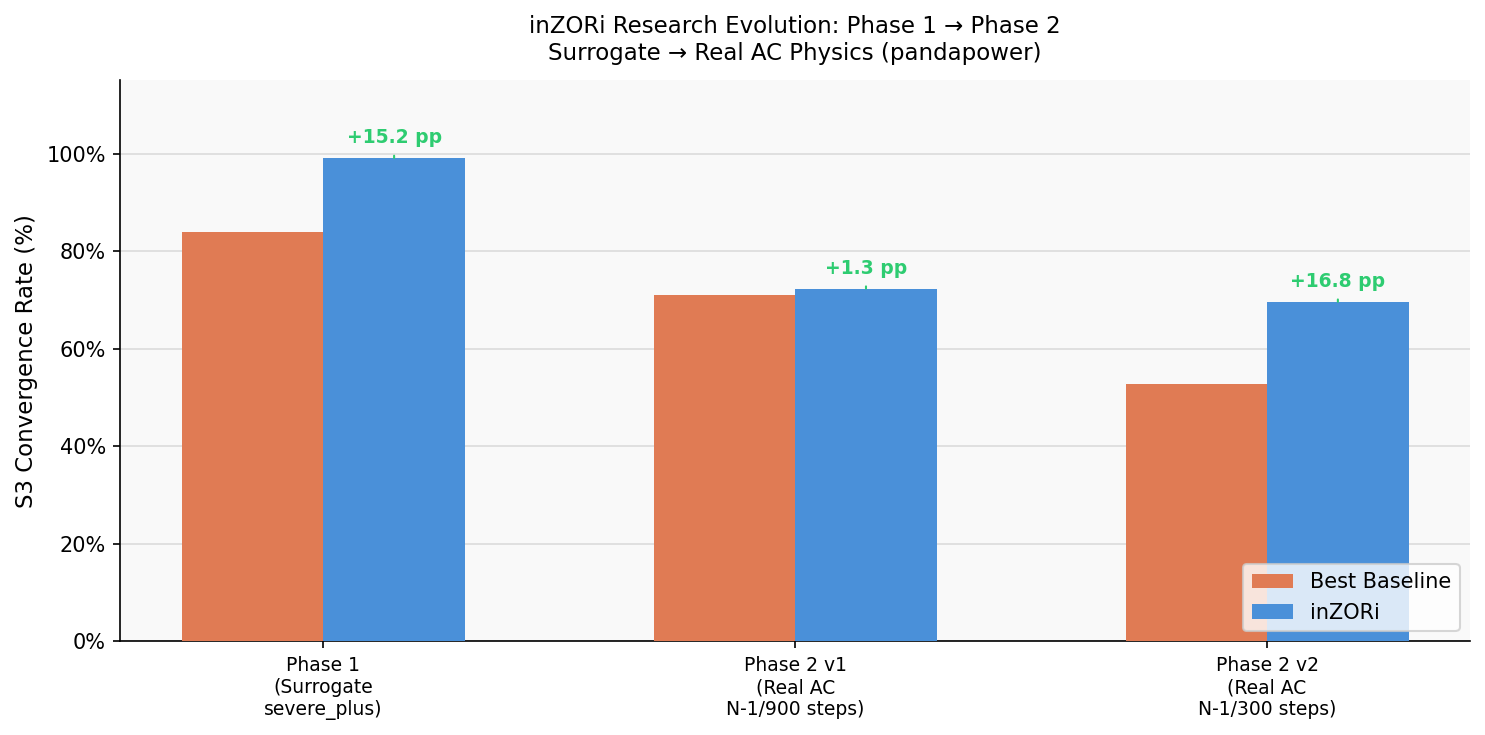
Phase 2 transitions from the controlled nonlinear surrogate (Phase 1) to full real AC Power Flow using pandapower on IEEE 118-bus — the first deployment of inZORi's Frozen Elite strategy on real grid physics. The operational regime is intentionally challenging: loads scaled to 1.75× nominal (near voltage-collapse boundary), Newton-Raphson budget constrained to nr_max=5, and N-1 topology shocks every 300 steps in S3 (3× more frequent than Phase 1). Static baselines converge at ~52% in S3. The inZORi Multi-Genome Frozen Elite selector achieves 69.6% S3 convergence (+16.8pp) over Baseline B, with N-1 recovery in 1.64 steps vs 6.7 steps for baselines (~4× faster). Validated across 20 independent seeds with CI95 non-overlap.
| Aspect | Phase 1 (surrogate) | Phase 2 (real AC PF) |
|---|---|---|
| Physics engine | Nonlinear surrogate (polynomial) | pandapower full AC Newton-Raphson |
| Network | 118-bus surrogate topology | IEEE 118-bus real admittance matrix |
| Load level | 1.0× nominal | 1.75× nominal (near-collapse) |
| NR budget | nr_max=8 | nr_max=5 (tighter) |
| N-1 frequency | Every 900 steps (S3) | Every 300 steps (S3) — 3× more frequent |
| inZORi strategy | FULL online evolution | Frozen Elite (offline-evolved, O(1) inference) |
| Baseline S3 conv. | ~84% | ~52% (real AC physics harder) |
| inZORi S3 conv. | 99.1% | 69.6% |
| Advantage (pp) | +15.2pp | +16.8pp |
The Frozen Elite approach evolves a pool of diverse genomes offline (~10 generations on the 118-bus task). At runtime, no evolution occurs — O(1) contextual selection from the pre-computed pool:
| # | Role | Profile |
|---|---|---|
| 0 | Balanced | Equilibrium between memory and exploration |
| 1 | Aggressive | Higher step scale, faster convergence attempt |
| 2 | Conservative | Low risk, stable in near-nominal conditions |
| 3 | High-memory | Strong warm-start bias, minimal exploration |
| 4 | N-1 recovery specialist | High DC-init jump tendency, activated on line outage |
| 5 | Diversifier | High step diversity, stress scenario coverage |
Genome #4 (N-1 specialist) is automatically selected upon N-1 shock detection, providing systematic recovery via DC power flow warm-start fallback. Exact genome parameters are proprietary.
| Strategy | S3 Conv. | CI95 | NR Iter (mean) | Recovery (steps) |
|---|---|---|---|---|
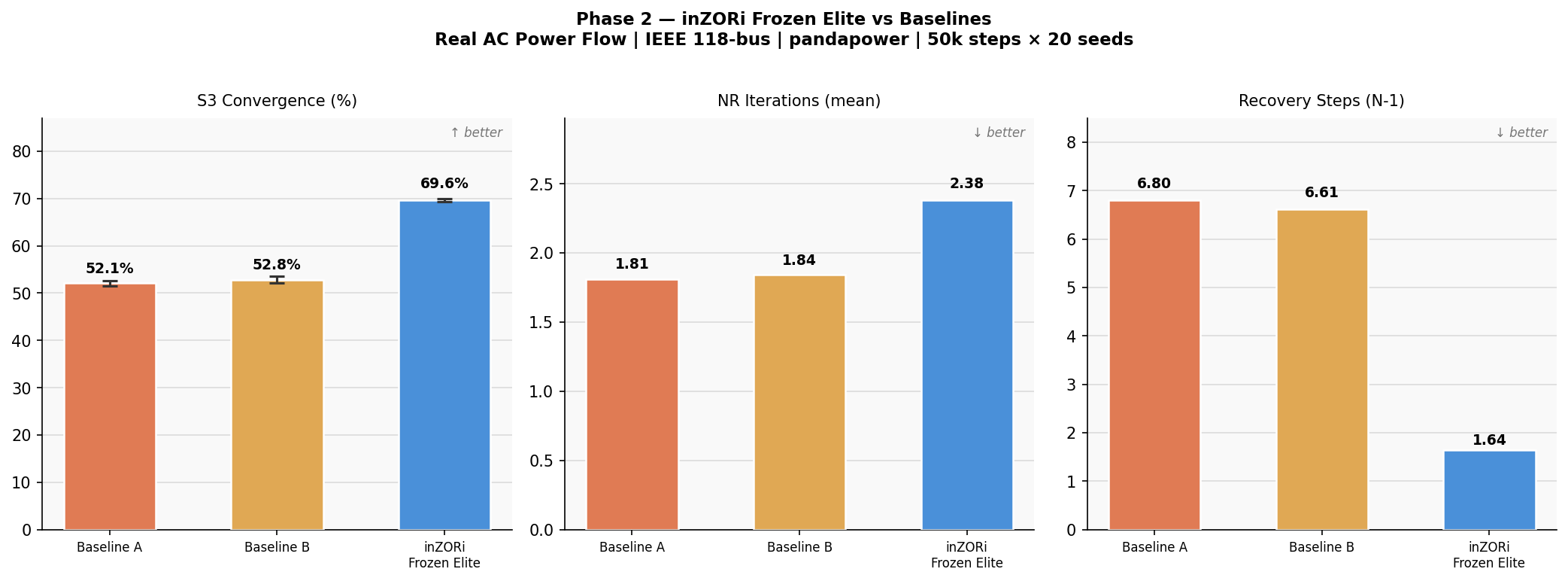
| Baseline A (warm-start) | 52.08% | [51.51, 52.65] | 1.81 | 6.80 |
| Baseline B (periodic reset) | 52.84% | [52.16, 53.51] | 1.84 | 6.61 |
| inZORi Frozen Elite | 69.63% | [69.33, 69.92] | 2.38 | 1.64 |
| Advantage vs Baseline B | +16.8pp ✓ | CI non-overlap ✓ | +0.54 iter | ~4× faster |
Note: inZORi's higher NR iteration count reflects DC-init retry usage — additional computation that directly enables higher convergence, i.e., the extra iterations are productive.