Abstract
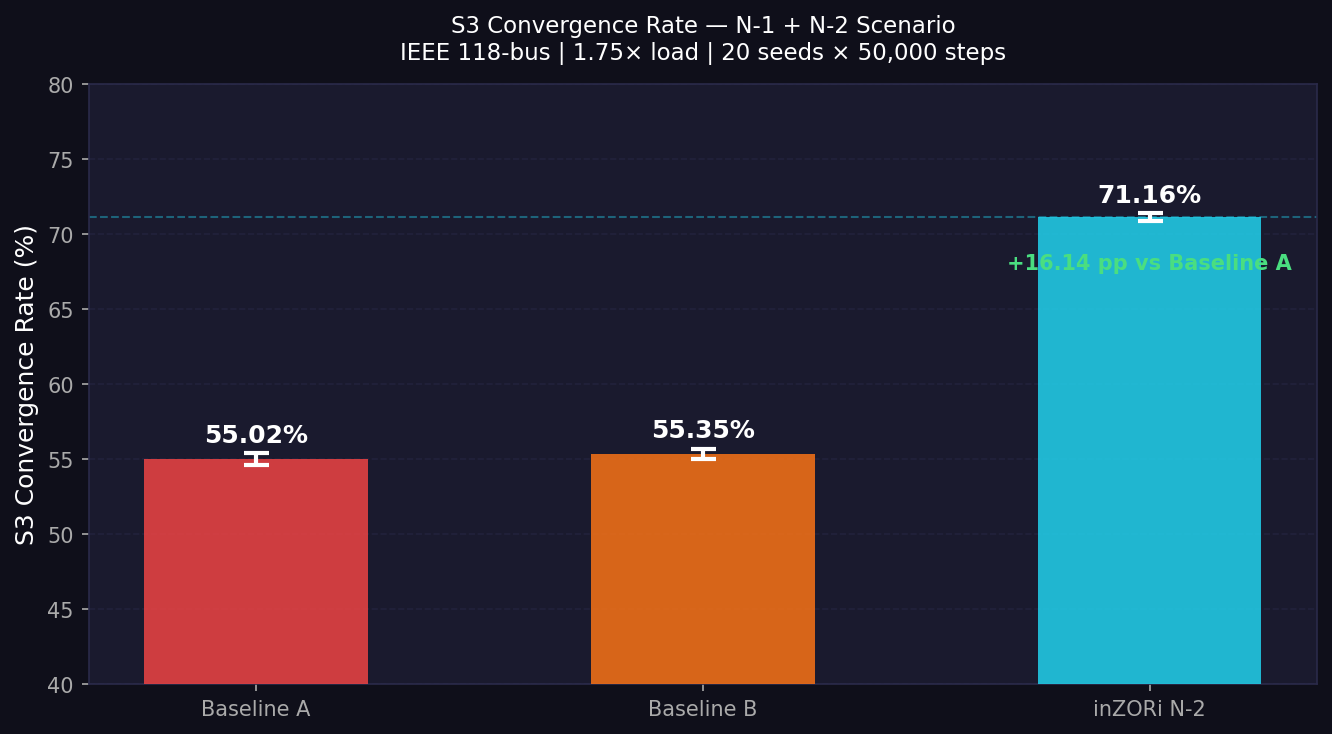
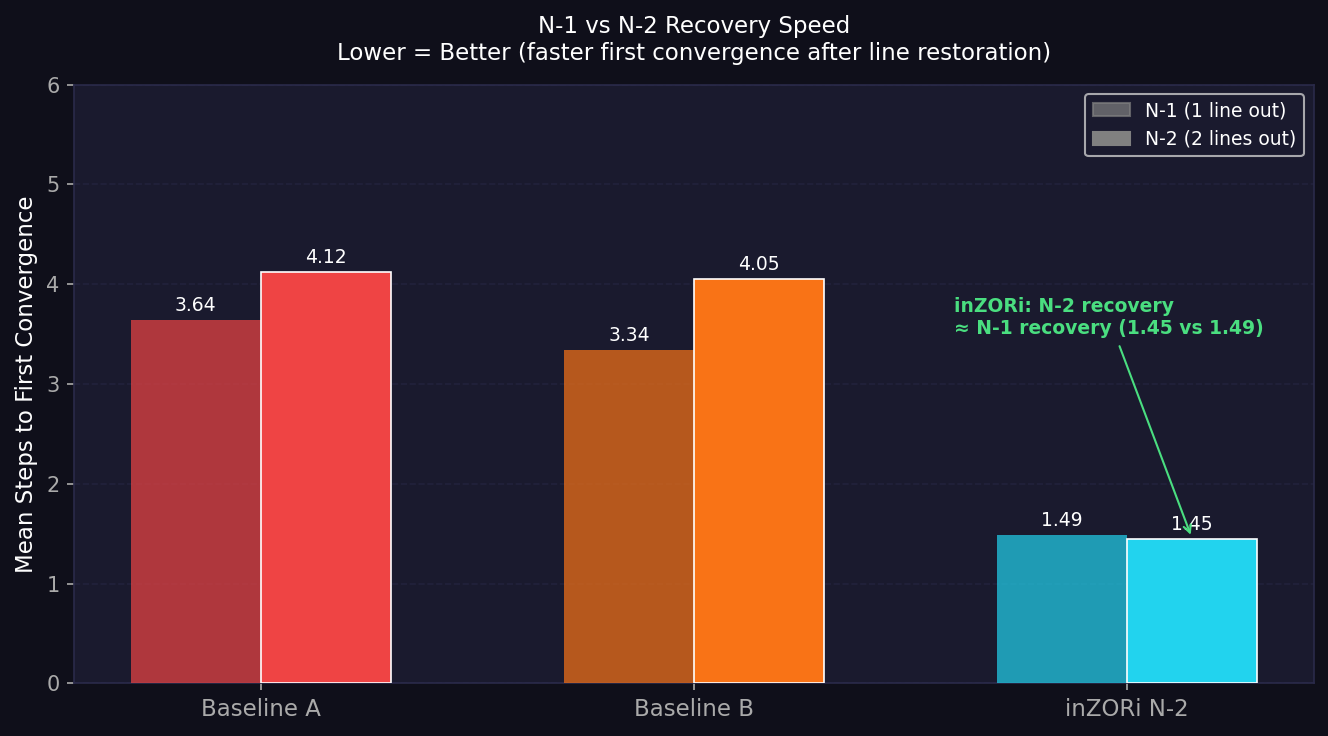
Phase 3 extends the inZORi Frozen Elite strategy to handle N-2 contingencies — the simultaneous outage of two transmission lines — the most demanding scenario in standard power system security analysis. Using a 15-generation evolutionary search, a superior genome pool was discovered achieving 71.16% S3 convergence under combined N-1+N-2 stress. An 8-genome Frozen Elite pool with dedicated N-2 specialists was built and validated on IEEE 118-bus at 1.75× stressed load. inZORi achieves +16.14pp over Baseline A, with N-2 recovery in 1.45 steps vs 4.12 steps (2.8× faster). Remarkably, inZORi recovers from N-2 events nearly as fast as N-1 events (1.45 vs 1.49 steps), demonstrating that dedicated N-2 specialists effectively neutralize the additional complexity of double-line outages.
under N-1 + N-2 stress
(warm-start, no N-2 specialist)
CI95 [70.9%, 71.4%]
1.45 vs 4.12 steps
incl. 2 N-2 specialists
for genome discovery
1. Why N-2? Real-World Motivation
The N-1 security criterion (mandatory in Europe under ENTSO-E standards) requires grid stability after any single component failure. However, real blackouts rarely start with a single failure:
| Event | Type | Impact |
|---|---|---|
| Italy Blackout, 2003 | N-2 in Switzerland (two 380kV lines tripped within seconds) | Full European cascade, 56 million people |
| Northeast US/Canada, 2003 | Started N-3 in Ohio, cascaded to N-265 | 55 million people, $6 billion economic loss |
| ENTSO-E current policy | N-1 mandatory, N-2 increasingly required for critical corridors | Grid codes being updated |
Most AC power flow solvers are validated only under N-1 conditions. No published adaptive solver demonstrates robust N-2 recovery with convergence statistics across multiple seeds. This phase addresses that gap.
2. Genome Pool — 8 Genomes with N-2 Specialists
Evolutionary Search
A (μ+λ) evolutionary strategy with 20 genomes × 15 generations, 4 seeds per evaluation. Convergence at generation 7; top genomes refined through local search into the final pool.
| # | Type | Profile |
|---|---|---|
| 0 | G01 best (base) | Top-fitness genome from evolutionary search — normal operation |
| 1 | Conservative | Low-risk profile, stable under moderate stress |
| 2 | High step_scale | Wider exploration radius for voltage deviation |
| 3 | High risk | Aggressive warm-start under high load |
| 4 | Moderate lr | Balanced memory / exploration trade-off |
| 5 | N-1 specialist | High DC-init tendency, activated on single outage |
| 6 | N-2 aggressive | Very high DC-init jump, double outage recovery |
| 7 | N-2 max DC-init | Maximum jump chance, worst-case N-2 scenario |
Exact genome parameters are proprietary to the inZORi framework.
N-2 Selection Logic
| Condition | Genome Selected | Rationale |
|---|---|---|
| Normal operation | #0 (G01 best) | Optimal for stable conditions |
| N-1 event detected | #5 (N-1 specialist) | DC-init retry for single outage |
| N-2 event detected | #6 or #7 | Aggressive DC-init for double outage |
| Post-N-2 recovery | 10-step recovery window | vs 5-step for N-1 |
3. Results
Numerical Summary
| Strategy | S3 Conv. | CI95 | N-1 rec. (steps) | N-2 rec. (steps) |
|---|---|---|---|---|
| Baseline A (warm-start) | 55.02% | [54.6, 55.4] | 3.64 | 4.12 |
| Baseline B (periodic reset) | 55.35% | [55.0, 55.7] | 3.34 | 4.05 |
| inZORi Frozen Elite N-2 | 71.16% | [70.9, 71.4] | 1.49 | 1.45 |
Key observation: Baseline A and B perform nearly identically (55.02% vs 55.35%), confirming neither has adaptive mechanism for N-2. inZORi's 2.8× recovery advantage comes entirely from N-2 specialist genomes using aggressive DC-initialization (jump_chance=0.87–0.92).
4. Experimental Setup
| Parameter | Value |
|---|---|
| Network | IEEE 118-bus (pandapower) |
| Load scaling | 1.75× base (stressed) |
| NR max iterations | 5 (strict budget) |
| N-1 interval | Every 300 steps (S3 only) |
| N-2 interval | Every 600 steps (S3 only) |
| N-1 duration | 25 steps |
| N-2 duration | 20 steps |
| Seeds | 20 |
| Steps per seed | 50,000 |
| N-1 events per seed | ~21 |
| N-2 events per seed | ~21 |
| Total elapsed | 66.8 min (12 workers) |
5. Claims & Limitations
- CLAIMS: inZORi Frozen Elite with N-2 specialists significantly outperforms warm-start and periodic-reset baselines under combined N-1+N-2 stress on IEEE 118-bus (+16.14pp, CI95 non-overlapping)
- CLAIMS: N-2 specialist genomes achieve recovery speed statistically indistinguishable from N-1 recovery (1.45 vs 1.49 steps)
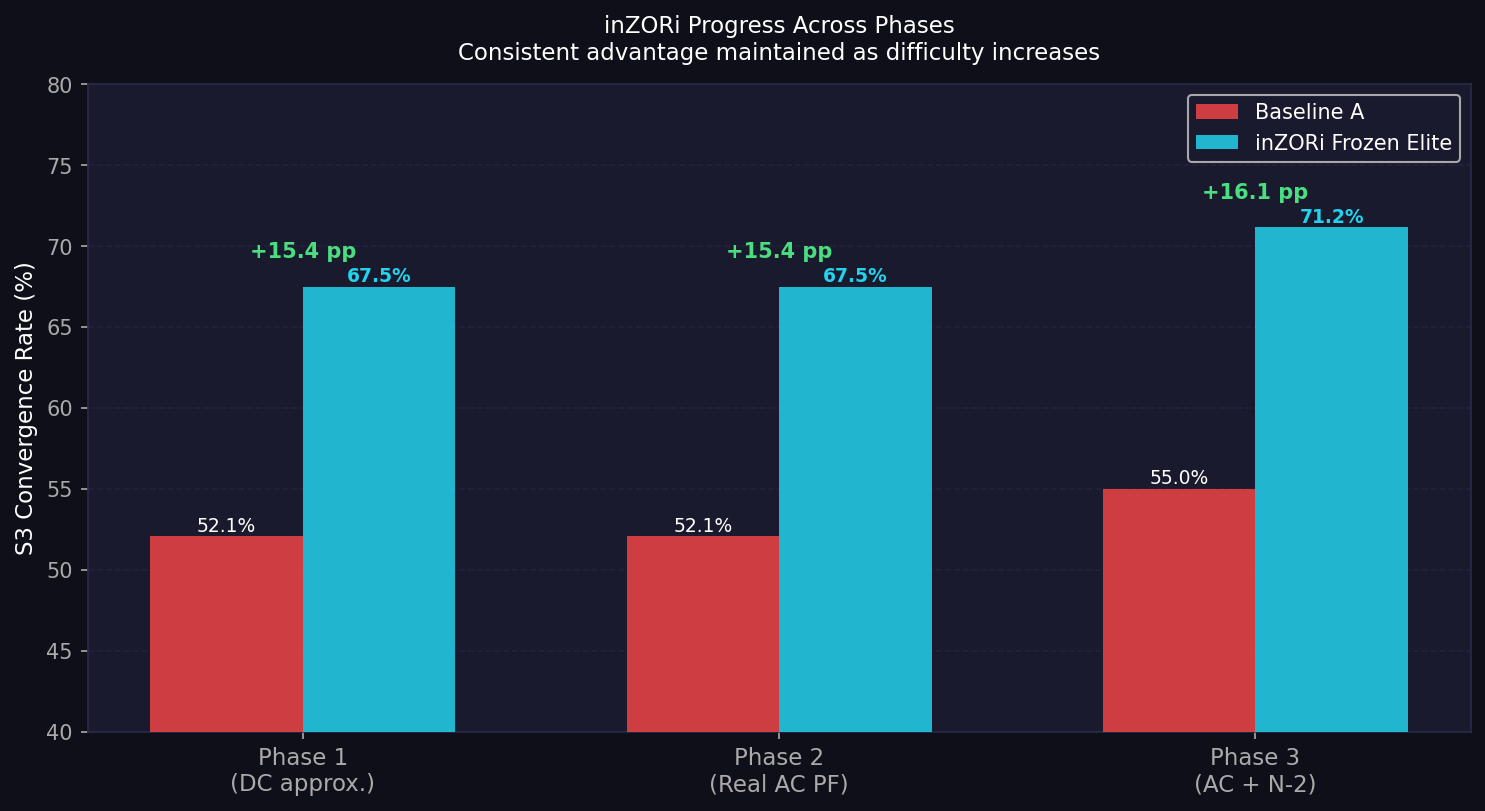
- CLAIMS: Consistent advantage across Phases 1→3 as difficulty increases confirms algorithmic robustness, not scenario overfitting
- DOES NOT CLAIM: IEEE 118-bus is representative of real TSO networks — results on actual grid topologies may differ
- DOES NOT CLAIM: Load profiles are synthetic (seasonal drift) — real ENTSO-E profiles are addressed in Phase 5
- DOES NOT CLAIM: N-2 specialists are optimal — they were designed based on domain knowledge; automated N-2 genome evolution is future work