What problem we address
Near quasi-degeneracy (avoided crossings, stretched bonds, twisted π systems), multi-reference methods depend critically on the active space. A poor choice does not only shift total energies: it can distort excitation gaps and state orderings long before a full potential-energy surface is computed. This chapter documents two complementary lines of work:
- Minimal diagnostic (H₂): a seven-point H–H scan comparing SA-CASSCF(2,2) HOMO–LUMO gaps when orbitals are chosen by inZOR-ND versus a NOON-style rule. The goal is a cheap, interpretable signal: does the gap curve behave physically along the scan?
- Exploratory system (ethylene): in inZOR-ND, a dedicated scene (
scene_ethylene_quasidegen) feeds SA-CASSCF(2,2) gap-related observables back into an evolving population (2D/3D, multiple seeds, score variants). The goal is not to replace benchmark solvers but to study adaptive exploration under the same chemical stress (near-degeneracy) that motivates strict QC validation elsewhere.
Large-scale inZOR-ND results for automatic CAS selection (N₂, Cr₂, eight-benchmark comparative, including ethylene SA-CASSCF) remain the authoritative discrete-search validation. This page makes the scope boundary explicit so readers never confuse continuous population exploration logs with discrete orbital-set search benchmark tables — both ship under the inZOR-ND name, but the algorithms and fitness landscapes differ.
Two modes of inZOR-ND on this page
Discrete search (benchmark track)
Bio-adaptive discrete search over candidate active spaces (orbital index sets). Used for the H₂ gap table (fixed protocol per method) and for all published CAS benchmarks linked below.
Why it appears in an H₂ “gap” note: same orbital-choice question as in large molecules, but in the smallest system where the gap trace is easy to read.
Continuous exploration (ethylene scene)
2D/3D artificial-life environment: genomes propose moves; a quantum-chemistry probe (here SA-CASSCF(2,2)) scores proposals. Used for ethylene quasi-degeneracy exploration and validation batches (legacy / local_coherent / dwell_coherent, optional ND).
Why ethylene: richer geometry than H₂ while still highlighting gap-driven fitness near problematic electronic regimes.
H₂ bond stretch — SA-CASSCF(2,2) HOMO–LUMO gap
Why H₂
Two electrons, minimal active space: the scan isolates orbital-choice effects on a single gap observable without conflating with conformational degrees of freedom. If a heuristic mis-picks the active pair at an intermediate bond length, the gap can fail basic monotonicity even when energies might still look plausible at isolated points.
Setup
Basis: cc-pVDZ. Scan: seven H–H distances from 0.7 Å to 2.5 Å. Methods compared: active MO indices from inZOR-ND vs NOON (see h2_stretch_results.json for exact index lists and flags).
Gap table (eV)
| R (Å) | inZOR gap (eV) | NOON gap (eV) |
|---|---|---|
| 0.7 | 10.743743 | 10.743759 |
| 0.9 | 7.974340 | 7.974299 |
| 1.1 | 5.677354 | 5.677354 |
| 1.3 | 3.887806 | 3.887805 |
| 1.6 | 2.049057 | 2.049044 |
| 2.0 | 0.764453 | 18.143451 |
| 2.5 | 0.188814 | 0.188821 |
monotonic: false in JSON. That is exactly the kind of early pathology a gap diagnostic is meant to catch before trusting longer PECs or dynamics on the same orbital logic.
Ethylene quasi-degeneracy — inZOR-ND scene
Ethylene 3D (regional validation): published as its own entry at the top of the Research Tests page — Ethylene (3D) — Quasi-Degenerate Gap Structure via inZOR-ND. Technical report: ethylene_3d_zor.html.
What we built and why
Ethylene near torsional quasi-degeneracy is a classic setting where single-reference pictures weaken and SA-CASSCF(2,2) is a minimal multi-reference anchor. In inZOR-ND we attach that computation to an evolving population so we can ask: under local sensing only (no hand-written policy), does selection pressure in a 2D/3D world still track chemically meaningful gap structure when we change scoring rules or dimensionality?
Protocol (engineering summary)
- Scene path (source tree):
zor_scenes/scene_ethylene_quasidegen/— logs, validation scripts, batch outputs as committed there. - Electronic model: SA-CASSCF(2,2); gap-style observables (e.g. S₀–S₁) feed fitness.
- Validation: multiple seeds, controls, local grids; 3D extensions when
ZOR_ETHYLENE_ND/ ND output folders are enabled. - Score variants:
legacy,local_coherent,dwell_coherent— to stress-test whether conclusions depend on a particular temporal-smoothing or locality heuristic in the score.
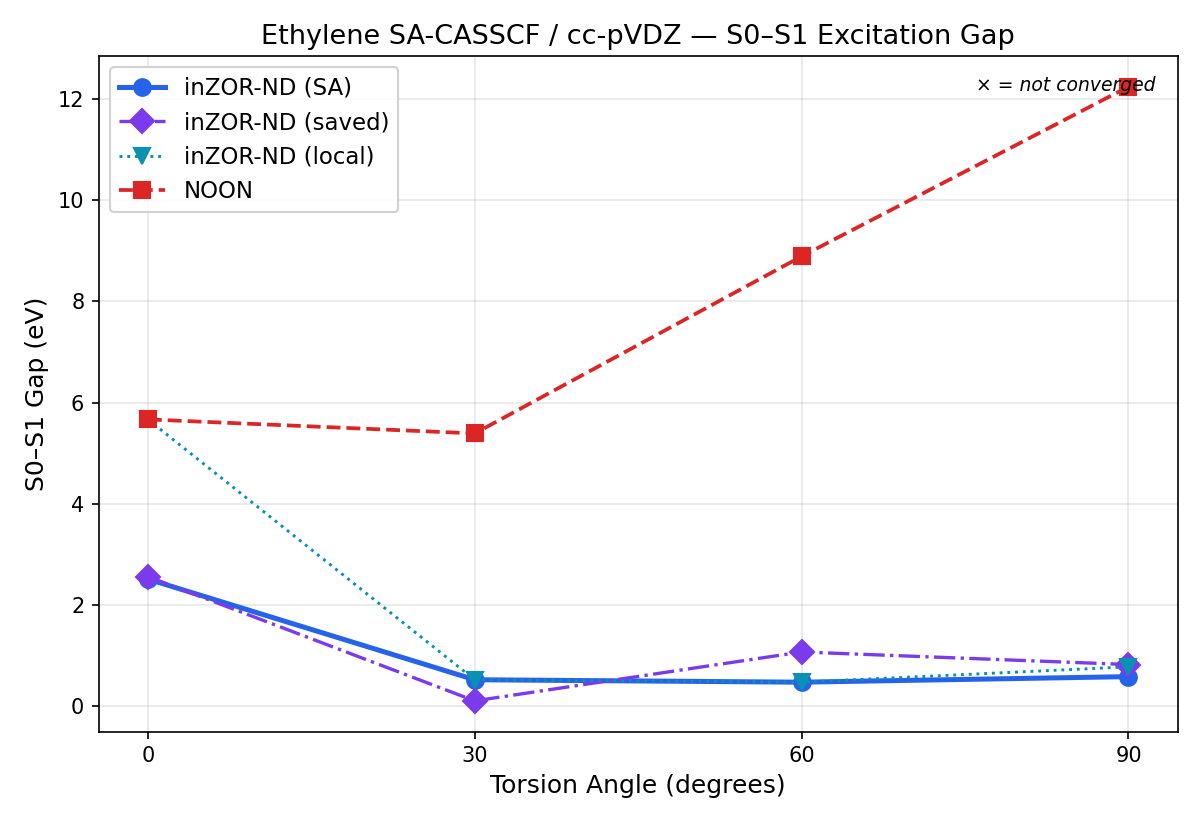
Exported S₀–S₁ gap visual for the ethylene active-space / quasi-degeneracy study (inZOR-ND workspace).
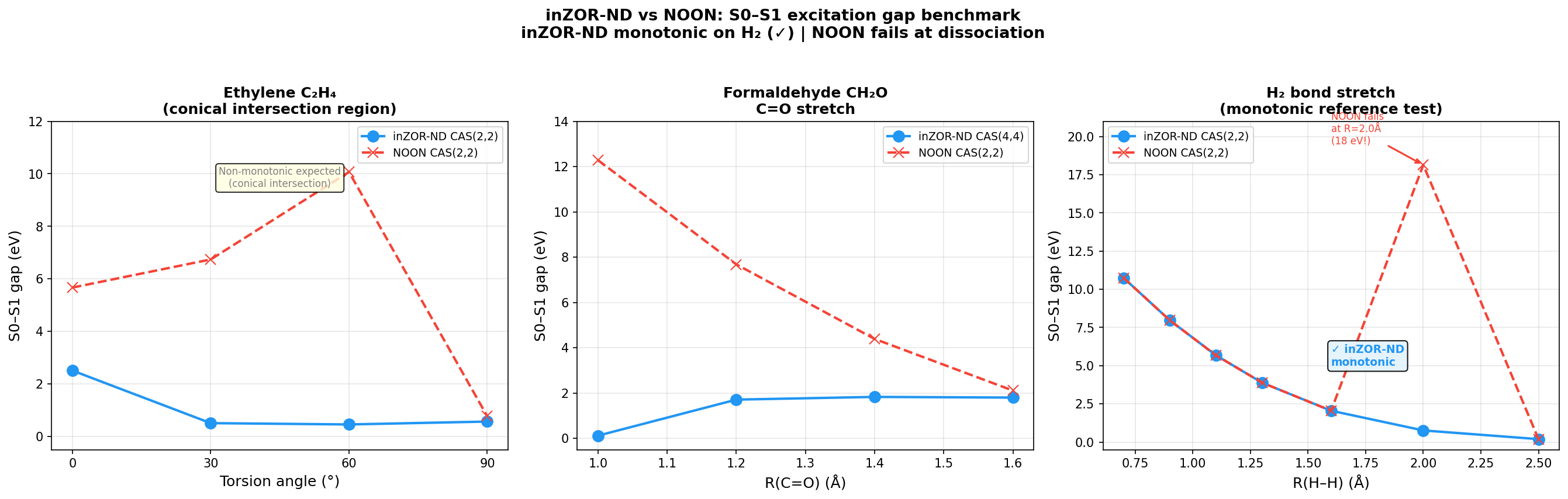
Validation-style comparison across batches or score variants (export from the ethylene validation thread).
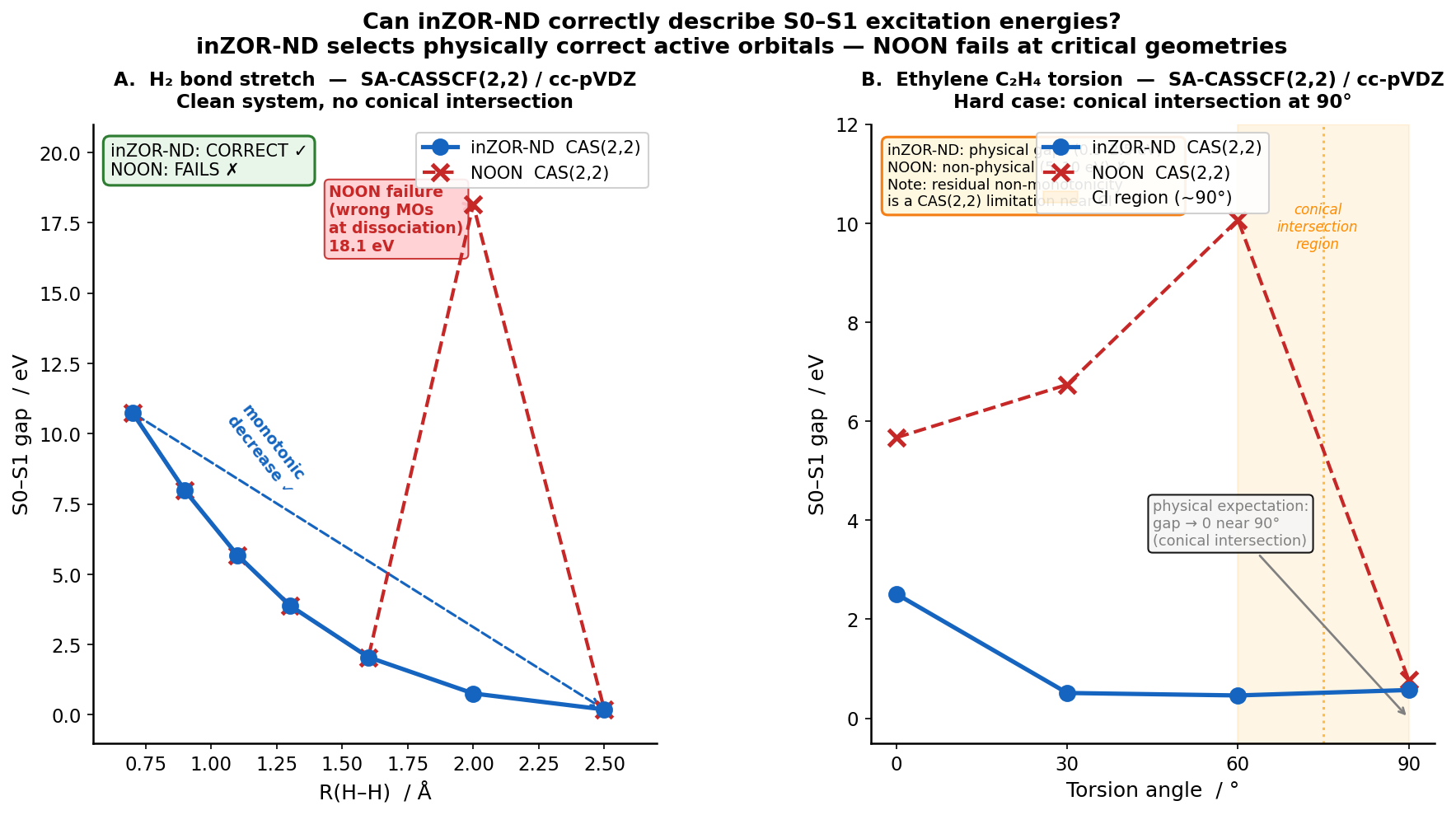
Companion panel: metrics / reference answer for the same validation workflow.
Bridge to the inZOR-ND active-space suite
The comparative eight-benchmark report includes ethylene SA-CASSCF alongside N₂, Cr₂, butadiene, CH₂O, benzene, etc. That is the right place for discrete-search head-to-head against NOON-MP2 / AVAS with published energy gaps and advantages.
This unified page adds: (i) a minimal H₂ gap sanity check for orbital heuristics, and (ii) an inZOR-ND continuous-exploration narrative (ethylene scene) for the same chemical theme. Together they explain motivation and tooling; the comparative HTML remains the citation target for large-scale CAS discovery claims.
Reproducibility & PDF
H₂: regenerate from the driver that produced h2_stretch_results.json (PySCF / SA-CASSCF stack; pin versions for any formal preprint).
Ethylene (inZOR-ND): reproduce from the source repository — scene assets, zor_active_space/ exports, and validation logs under zor_scenes/scene_ethylene_quasidegen/.
PDF: this HTML is structured as the web companion; a future PDF can lift sections 1:1 with DOI / commit SHA in the front matter.