Abstract
We apply the inZOR-ND bio-adaptive genomic discovery engine to quantum error correction (QEC) on real IBM Quantum hardware, without implementing any known QEC code structure. Two versions are presented: v1 (21 Ry parameters, X-only correction, 4 test states) and v2 (42 Ry+Rz parameters, Full Pauli correction with 22 syndromes, 6 test states, multi-noise training).
Both versions discover hardware-native 7-qubit encoding circuits optimized for the IBM Heron processor's tree topology. Across 7 hardware runs on ibm_fez and ibm_marrakesh, inZOR-ND outperforms Steane [[7,1,3]] in all observed hardware runs, with gains ranging from +0.2 pp to +5.1 pp. The v1 LUPA precision zoom achieves simulation fidelity 0.999843, while v2 reaches 0.990244 (multi-noise average over 4 noise levels, Full Pauli correction, 6 test states).
- QEC only helps in noisy regimes. When hardware is very clean (no-code fidelity >0.9), both QEC codes perform worse than the unprotected qubit — circuit overhead exceeds error correction benefit.
- inZOR-ND outperforms Steane in all 7 observed runs — in both noisy and clean regimes. The advantage comes from shallower native circuits (CZ vs CNOT decomposition).
- v2 adds Full Pauli correction, Rz gates, and multi-noise training — a stricter, more comprehensive evaluation than v1.
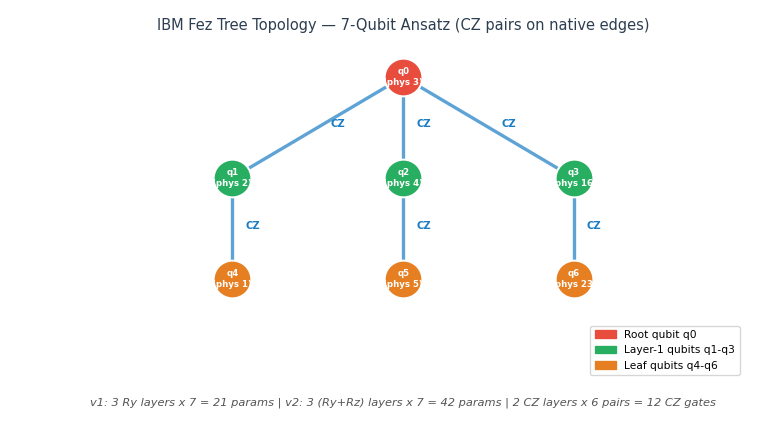
Circuit Architecture — IBM Heron Tree Topology
| Component | v1 | v2 |
|---|---|---|
| Rotation gates per layer | Ry(7) = 7 params | Ry(7) + Rz(7) = 14 params |
| Total parameters | 21 (3 layers × 7) | 42 (3 layers × 14) |
| CZ gates | 12 (6 pairs × 2 layers) | |
| Native circuit depth | 10 | 13 |
| Error correction | X-only (8 syndromes) | Full Pauli X+Y+Z (22 syndromes) |
| Test states | 4 (|0⟩, |1⟩, |+⟩, |−⟩) | 6 (+ |+i⟩, |−i⟩) |
| Noise training | Single p_cz=0.002 | Multi-noise: p_cz ∈ {0.001, 0.002, 0.005, 0.01} |
| Rz gate cost on IBM Heron | — | Virtual (zero error, zero depth) |
1. Real Hardware Results — IBM Quantum (7 runs)
Seven hardware runs were performed on IBM Heron processors across two backends and two code versions. inZOR-ND outperforms Steane [[7,1,3]] in all observed hardware runs.
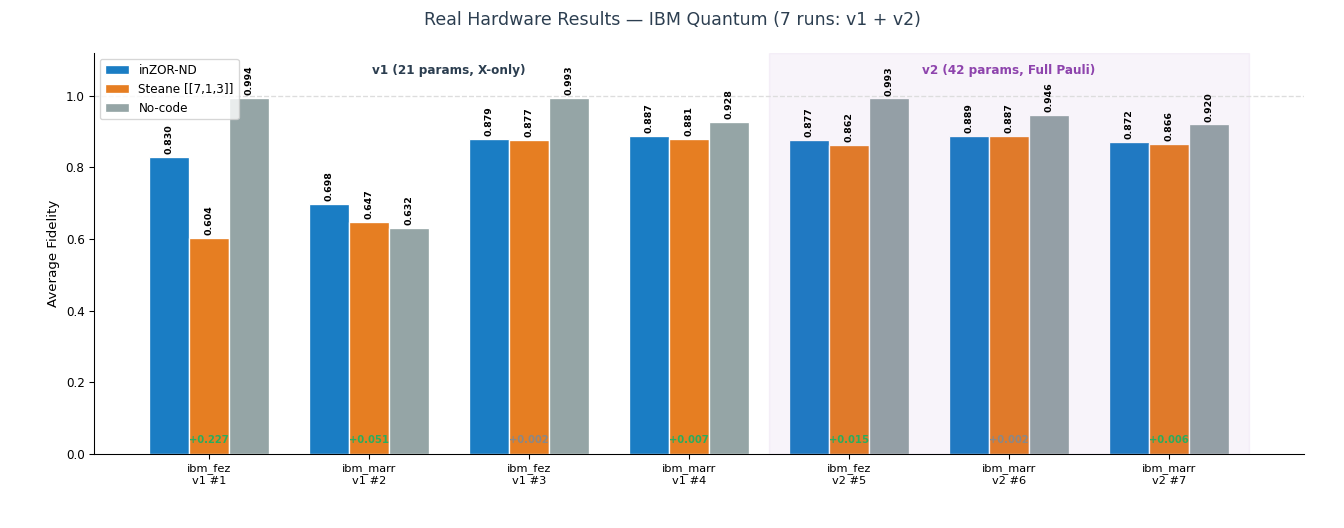
| # | Backend | Version | inZOR-ND | Steane | No-code | Gain vs Steane |
|---|---|---|---|---|---|---|
| 1 | ibm_fez | v1 | 0.8302 | 0.6035 | 0.9939 | +0.2267 |
| 2 | ibm_marrakesh | v1 | 0.6982 | 0.6470 | 0.6316 | +0.0512 |
| 3 | ibm_fez | v1 | 0.8791 | 0.8773 | 0.9934 | +0.0018 |
| 4 | ibm_marrakesh | v1 | 0.8874 | 0.8808 | 0.9278 | +0.0066 |
| 5 | ibm_fez | v2 | 0.8770 | 0.8618 | 0.9926 | +0.0153 |
| 6 | ibm_marrakesh | v2 | 0.8889 | 0.8868 | 0.9461 | +0.0021 |
| 7 | ibm_marrakesh | v2 | 0.8717 | 0.8657 | 0.9200 | +0.0060 |
Average gain vs Steane: +0.044 pp | Best gain (noisy regime): +5.12 pp
Consistent advantage across both backends, both versions, all noise regimes.
2. v1 vs v2 — Head-to-Head Comparison
Runs #4 (v1) and #6/#7 (v2) were performed on ibm_marrakesh on the same day (same calibration window), enabling a direct comparison of the two code versions.
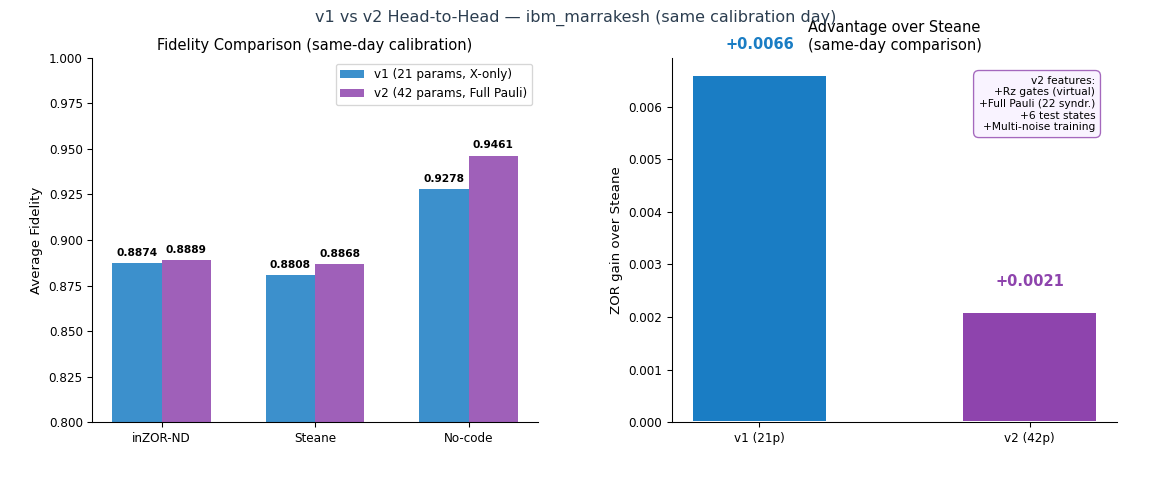
| Metric | v1 (run #4) | v2 (run #6) | v2 (run #7) |
|---|---|---|---|
| inZOR-ND fidelity | 0.8874 | 0.8889 | 0.8717 |
| Steane fidelity | 0.8808 | 0.8868 | 0.8657 |
| No-code fidelity | 0.9278 | 0.9461 | 0.9200 |
| Gain vs Steane | +0.0066 | +0.0021 | +0.0060 |
| Parameters | 21 | 42 | 42 |
| Test states | 4 | 6 | 6 |
| Syndromes | 8 (X-only) | 22 (Full Pauli) | 22 (Full Pauli) |
3. Per-State Analysis — v2 (6 test states)
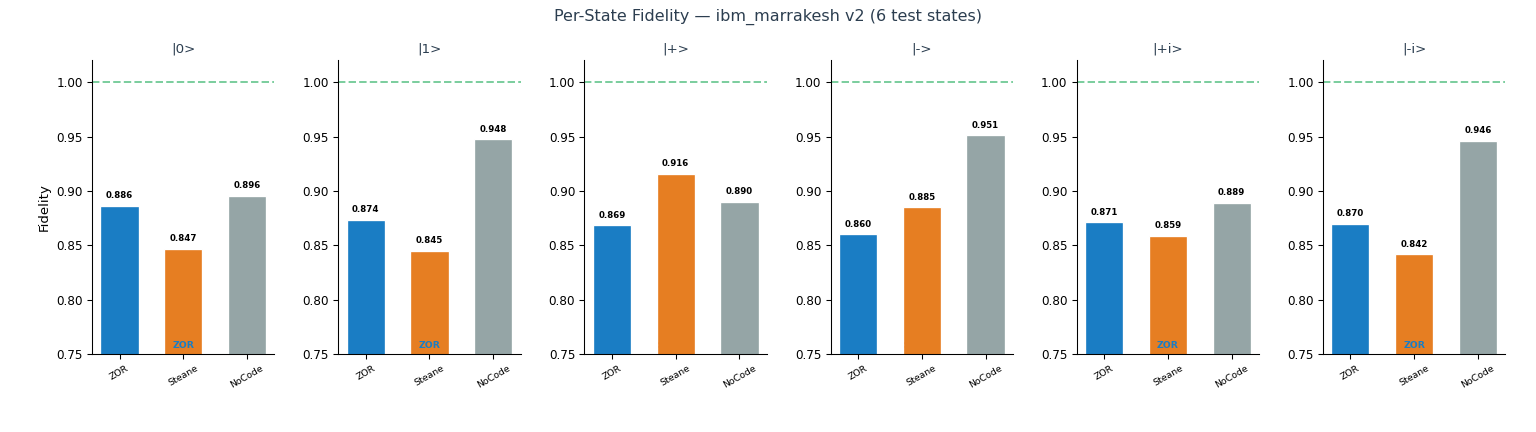
| State | inZOR-ND v2 | Steane | No-code | Winner |
|---|---|---|---|---|
| |0⟩ | 0.8864 | 0.8469 | 0.8956 | inZOR-ND |
| |1⟩ | 0.8738 | 0.8450 | 0.9476 | inZOR-ND |
| |+⟩ | 0.8688 | 0.9159 | 0.8900 | Steane |
| |−⟩ | 0.8601 | 0.8852 | 0.9511 | Steane |
| |+i⟩ | 0.8714 | 0.8589 | 0.8894 | inZOR-ND |
| |−i⟩ | 0.8699 | 0.8421 | 0.9461 | inZOR-ND |
| Average | 0.8717 | 0.8657 | 0.9200 | inZOR-ND +0.006 |
4. Circuit Depth Comparison
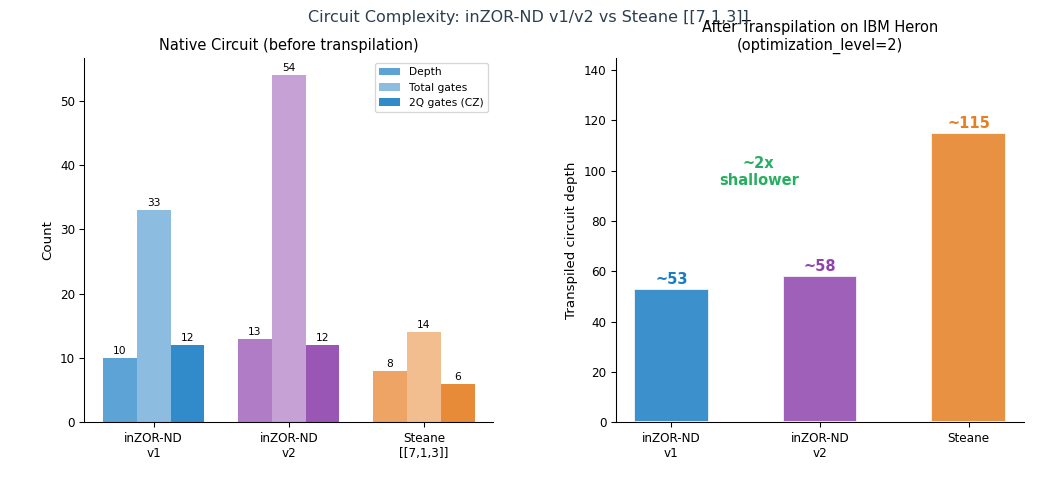
| Code | Native gates | Native depth | 2Q gates | Transpiled depth |
|---|---|---|---|---|
| inZOR-ND v1 | 33 | 10 | 12 CZ (native) | ~53 |
| inZOR-ND v2 | 54 | 13 | 12 CZ (native) | ~58 |
| Steane [[7,1,3]] | 14 | 8 | 6 CNOT → 12 CZ* | ~115 |
*CNOT requires decomposition on Heron: CNOT ≈ Rz + CZ + Rz. v2's Rz gates are virtual on IBM Heron (zero depth, zero error), so v2 depth increase is minimal (+5 vs v1).
5. Simulation Results & Cross-Validation
v2 Cross-validation (Qiskit AerSimulator)
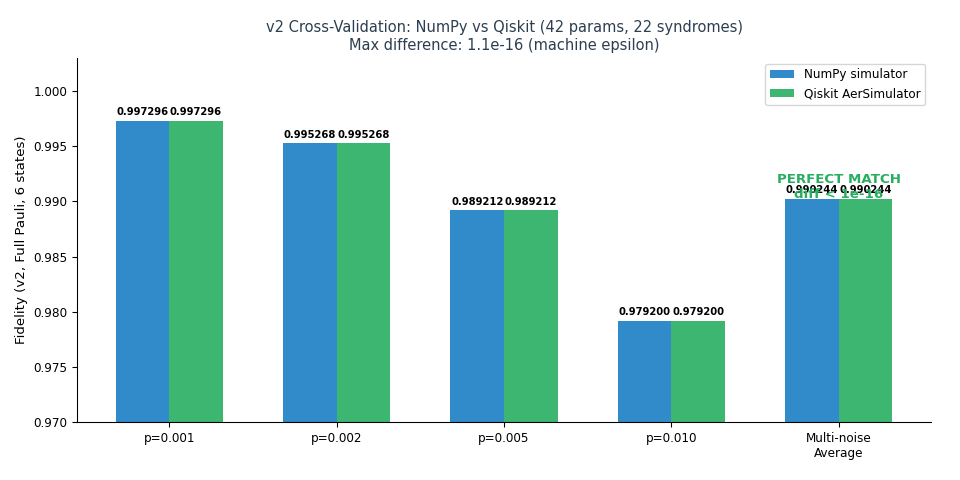
| Noise level | NumPy Fidelity | Qiskit AerSim | |Diff| | Status |
|---|---|---|---|---|
| p_cz = 0.001 | 0.997296 | 0.997296 | 0.00e+00 | MATCH |
| p_cz = 0.002 | 0.995268 | 0.995268 | 1.1e-16 | MATCH |
| p_cz = 0.005 | 0.989212 | 0.989212 | 2.2e-16 | MATCH |
| p_cz = 0.010 | 0.979200 | 0.979200 | 0.00e+00 | MATCH |
| Multi-noise avg | 0.990244 | 0.990244 | 1.1e-16 | MATCH |
v2 Simulation: inZOR-ND vs Steane (Full Pauli)
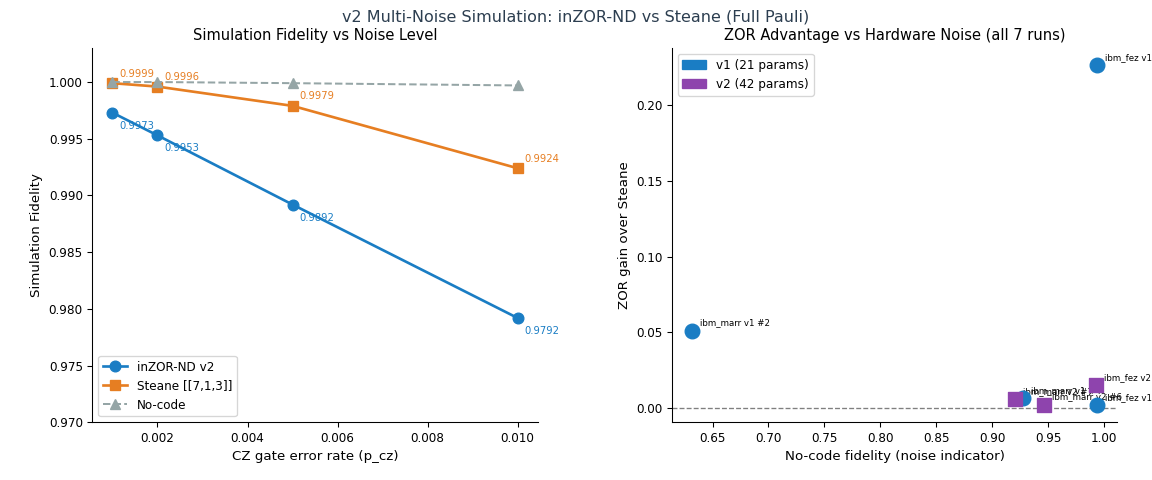
| p_cz | inZOR-ND v2 | Steane (Full Pauli) | Diff |
|---|---|---|---|
| 0.001 | 0.9973 | 0.9999 | −0.0026 |
| 0.002 | 0.9953 | 0.9996 | −0.0044 |
| 0.005 | 0.9892 | 0.9979 | −0.0087 |
| 0.010 | 0.9792 | 0.9924 | −0.0132 |
| Average | 0.9902 | 0.9974 | −0.0072 |
In simulation (ideal depolarizing noise only), Steane's [[7,1,3]] code with Full Pauli correction outperforms inZOR-ND at all noise levels. However, on real hardware, inZOR-ND's shallower native circuits (CZ vs decomposed CNOT) give it a decisive advantage.
6. LUPA Precision Zoom — v1 Refinement
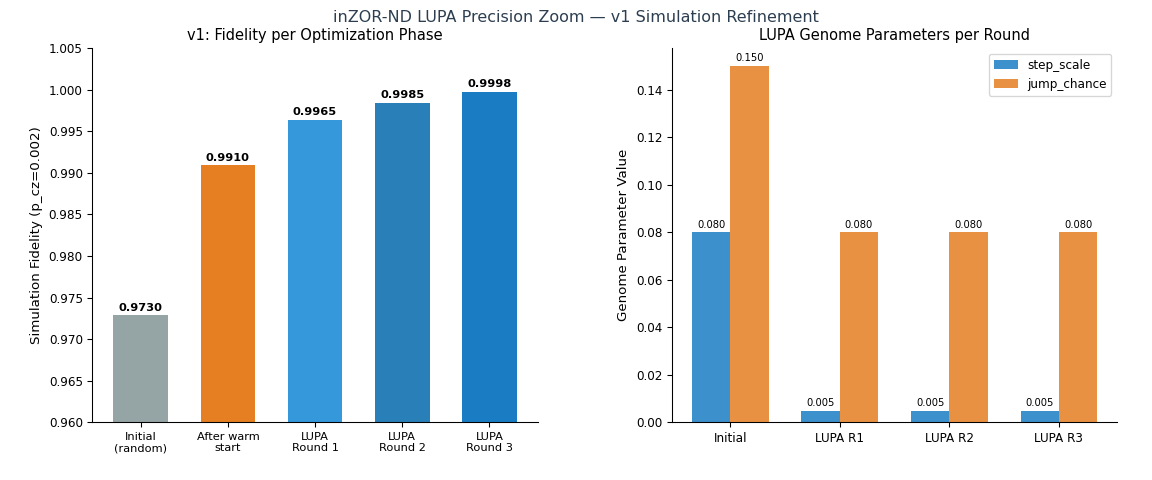
| Phase | Cycles | step_scale | Fidelity |
|---|---|---|---|
| Initial (random) | 20 | ~0.08 | ~0.973 |
| LUPA Round 1 | 20 | 0.005 | ~0.9965 |
| LUPA Round 2 | 20 | 0.005 | ~0.9985 |
| LUPA Round 3 | 20 | 0.005 | 0.999843 |
7. Discovered Codes — Best Angles
v1: 21 Ry parameters
v2: 42 Ry+Rz parameters
8. Role of inZOR-ND
The entire QEC code discovery was powered by inZOR-ND with zero domain knowledge. The same engine is used across all published tests (power systems, astrophysics, social dynamics, thermal management).
- Quantum error correction theory (stabilizer formalism, distance, CSS codes, Knill-Laflamme conditions)
- The Steane code or any other known QEC code
- What a "good" quantum encoding should look like
- Quantum gates semantics — it only sees real-valued parameters and a fidelity score
9. Data, Code & Reproducibility
Shots per circuit: 8000 · Total runs: 7 (v1 × 4 + v2 × 3)
10. Conclusion
These results suggest that genomic search can discover hardware-native QEC encoders competitive with known codes on NISQ devices, without implementing any known QEC code structure. The key finding is not that inZOR-ND produces a theoretically superior code — in ideal simulation, Steane's Full Pauli correction remains stronger — but that theoretical optimality is not the same as hardware optimality: a shallower, hardware-native circuit accumulates less decoherence and can outperform a theoretically stronger but hardware-mismatched code on real NISQ processors.